



AI Agents vs Automation: Which Is Scaling Businesses Faster?
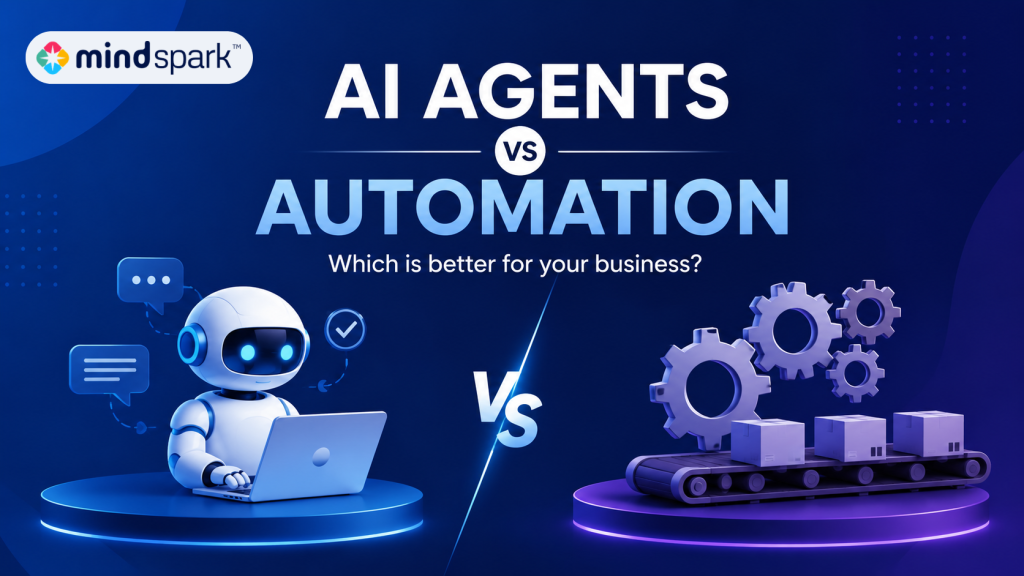
Every business owner asking this question right now deserves a straight answer, not a technology lecture. So here it is, automation does exactly what you tell it to do, every time. AI agents decide what to do, based on what is actually happening. Its seems like an easy one but it affects the way you plan, budget and expand your business. Make it right, and you gain some serious efficiency. Do it wrong and you have tools that are too costly to deal with but not use. In this guide cuts through the noise of AI agents vs automation, identifies when each works best, and demonstrates how MindSpark can assist businesses in implementing AI agents and AI automation, the right way. What Is Traditional Automation? Traditional automation is based on prewritten rules. It will carry out your instructions without error and will halt when it encounters something. The type of automation that has been aiding business operations for decades. Payroll runs, invoice processing, scheduled emails, integration with other platforms, all of it reliable, fast and consistent as long as nothing changes. Traditional automation works best for: Running payroll and attendance calculations on schedule Triggering follow-up emails after a form submission Syncing sales data between your CRM and accounting tools Generating weekly or monthly performance reports automatically The limitation is real though. The moment your process changes a new data format, an edge case, a workflow that evolved, traditional automation either fails silently or throws the task back to a human. It has no capacity to reason. It only knows what you told it. What are AI Agents and What makes them different? Companies rely on AI Agents for business to understand context, process information and take action. These smart software systems achieve your goals without needing a human to script every step in advance. Unlike traditional automation, Agentic AI does not wait for the trigger. It analyzes the situation and decides what to do next. Here is a simple comparison of AI Agents vs Traditional Automation. Traditional automation functions exactly like a vending machine. You press a button and the machine drops the exact same item every time. On the other side, Autonomous AI agents work more like team members. They understand the exact outcome you want and figure out the best way to achieve it, even when they face the new challenges. The reason Agentic AI vs Traditional Automation has become such a pressing conversation for businesses is not just hype. Traditional automation cannot handle ambiguity, but AI agents manage it easily. Furthermore, everyone knows that most real business environments constantly face unclear situations. AI agents for enterprise automation and SMBs excel at: Qualifying leads based on real-time conversation signals and behaviour Managing multi-step customer support queries that change direction mid-conversation Coordinating tasks across tools and departments without constant human handoffs Adapting marketing responses based on user intent, not just predefined segments Autonomous AI agents do not replace human judgment, they extend it to the places where humans are currently stretched too thin. AI Agents vs Traditional Automation: Head-to-Head Traditional Automation AI Agents / Agentic AI Decision-Making Follows fixed, pre-set rules Reasons and adapts based on context Best For Repetitive, predictable tasks Complex, variable workflows Flexibility Low – breaks on new inputs High – handles ambiguity Human Input Minimal after initial setup Collaborative; humans stay in control Cost Profile Lower upfront, limited ROI ceiling Higher upfront, strong long-term ROI Scalability Capped by programmed scope Expands across functions and teams MindSpark Fit M HRMS payroll, M CRM data sync M CRM lead qualification, AI Agent workflows Note: The MindSpark Fit row shows real examples of how we apply each approach inside our own product ecosystem, M CRM and M HRMS. Stick with traditional automation when: Your process runs identically every single time Speed and accuracy on a known task matter more than adaptability You need a quick, low-cost win on a well-defined workflow Your team does not yet have the bandwidth to manage or monitor an AI system Move to AI agents for business when: Your workflows involve judgment calls, variable inputs, or multiple decision points You want to scale personalised customer or employee experiences without adding headcount You need a system that improves as your data and usage grows Your team is burning hours on tasks that require thinking, not just clicking The businesses prevent making an either or choice between these tools. Instead, they use traditional automation to manage predictable, repetitive work with perfect efficiency. At the same time, they deploy autonomous AI agents in areas where flexibility and smart reasoning truly matter. By combining both approaches, these companies solve far more challenges than either system could handle on its own. How MindSpark Delivers AI Agents and Automation for Your Business Most vendors just sell you a basic tool, but MindSpark builds a complete system for you. We design this system around how your business actually works, instead of just slapping your logo onto a generic template. Our AI Agent & Automation process starts with a diagnostic, not a sales demo. Before we recommend any solution, we map out your current workflows and find exactly where your team loses the most time. We then figure out which tasks need simple, rule based automation and which ones require the smart reasoning of agentic AI. This clear choice guides every step we take next. What this looks like in practice: For a logistics company, we built automated dispatching rules for standard routes and deployed an AI agent to handle exceptions, rerouting, and supplier communication in real time. For a retail business, traditional automation handles inventory alerts and scheduled reports inside M HRMS, while an AI agent inside M CRM actively qualifies inbound leads, personalises follow-ups and flags high-intent prospects for the sales team. For a healthcare provider, we used automation to process routine appointment confirmations and billing triggers, while an autonomous AI agent manages patient queries, triages requests, and escalates complex cases to the right staff –